Cruise Ship Crew Slang: 50 Words You’ll Hear Onboard
Decode directions, work routines and casual crew conversation with a pocket glossary that separates useful maritime terms from informal expressions and company jargon.
Saving is unavailable in this browser (its storage is turned off or full). Ordinary links and bookmarks still work.View saved
Crew conversation mixes maritime terminology, company shorthand and ordinary slang. These 50 entries give you a starting vocabulary, not a universal onboard dialect. Formal means established maritime terminology; workplace means employment language; everyday means common descriptive language; informal means casual speech whose use varies.
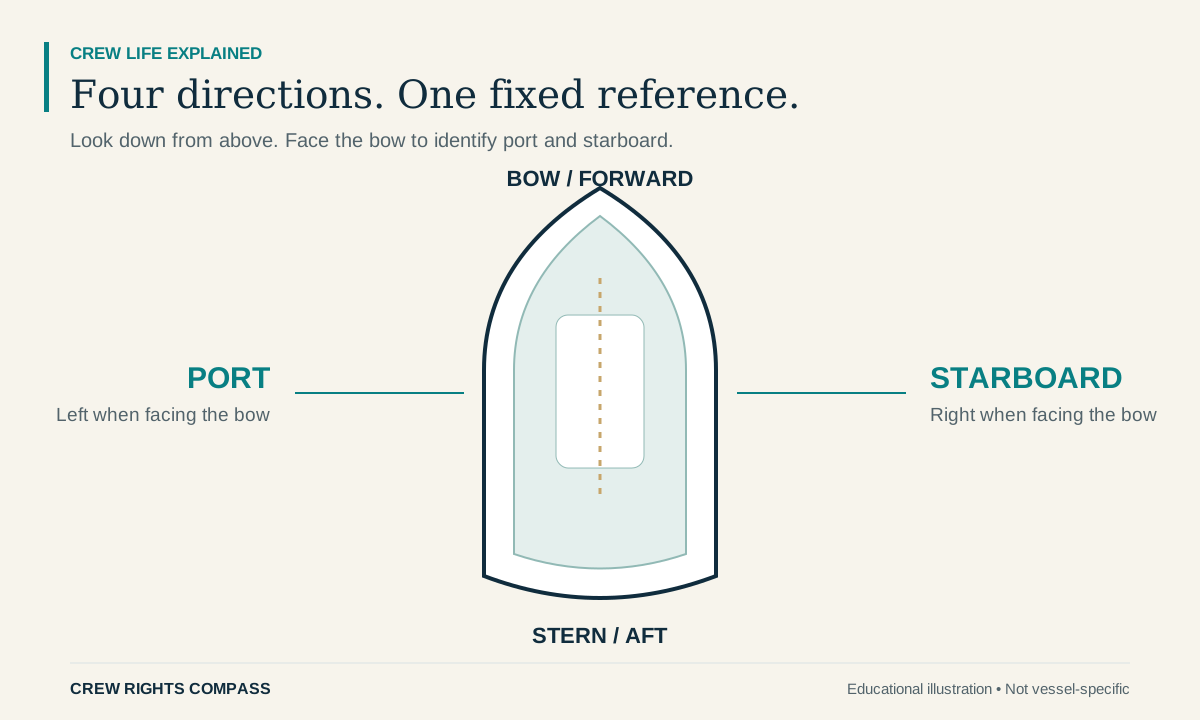
Four directions. One fixed reference.
- Look down from above. Face the bow to identify port and starboard.
- Port: left when facing the bow.
- Starboard: right when facing the bow.
- Bow / forward at one end; stern / aft at the other.
Educational illustration; arrangements vary by vessel. Open the full-size diagram: Four directions. One fixed reference.
No matching terms. Try another word.
Finding your way
- Port, formal: The ship’s left side when you face its bow; also a harbour.
- Starboard, formal: The ship’s right side when you face its bow.
- Bow, formal: The forward end of the ship.
- Stern, formal: The rear end of the ship.
- Forward, formal: Towards the bow.
- Aft, formal: Towards the stern.
- Amidships, formal: Around the ship’s middle.
- Deck, formal: A ship’s floor or horizontal level.
- Bulkhead, formal: A wall or partition aboard a ship.
- Overhead, formal: The ceiling above you.
- Bridge, formal: The ship’s navigation and command area.
- Galley, formal: The shipboard kitchen.
- Mess, formal: A crew dining area; access arrangements vary.
- Gangway, formal: The access route used to board or leave.
- Berth, formal: A ship’s allotted mooring place, or a sleeping space.
Understanding the working day
- Watch, formal: A scheduled duty period, often for operational teams.
- Handover, formal: Passing relevant responsibilities and information to the next person.
- Muster, formal: An assembly, often connected with safety duties or checks.
- Muster station, formal: Your designated assembly location for specified situations.
- Drill, formal: A planned exercise to practise an assigned response.
- PPE, formal: Personal protective equipment appropriate to the task.
- Ship time, everyday: The time officially used aboard your ship.
- All aboard, everyday: The announced deadline to be back onboard.
- Sea day, everyday: An itinerary day without a scheduled port call.
- Port day, everyday: A day when the ship visits a port.
- Turnaround day, everyday: One voyage ends and the next begins.
- Embarkation, formal: Boarding a ship.
- Disembarkation, formal: Leaving a ship.
- Shore leave, formal: Authorised time ashore, subject to applicable arrangements.
- Tender, formal: A smaller boat transferring people between ship and shore.
Jobs, joining and leaving
- Master, formal: The captain in command of the vessel.
- Bosun, formal: A deck supervisory role; short for boatswain.
- Cadet, formal: A trainee following a structured professional training route.
- Purser, formal: An administrative or financial title with company-specific responsibilities.
- Sign on, workplace: Join the ship’s crew through its joining process.
- Sign off, workplace: Leave a shipboard assignment through its departure process.
- New joiner, workplace: Someone newly arriving for an onboard assignment.
- Rehire, workplace: A returning employee; arrangements depend on the employer.
- Rotation, workplace: An arrangement of periods working and periods away.
- Shoreside, workplace: A company team or operation based on land.
Casual crew conversation
- Newbie, informal: Someone new to the job or ship.
- Old hand, informal: Someone with experience; not a formal rank.
- Sea legs, informal: Feeling accustomed to a ship’s movement.
- Scuttlebutt, informal: Rumour or gossip; not a reliable information source.
- Back-to-back, informal: Consecutive voyages; clarify whether someone means guests or work.
- Crew bar, everyday: A designated social venue for crew, where provided.
- Crew mess, everyday: A dining space designated for crew.
- Cabinmate, everyday: The person sharing your cabin.
- Day off, everyday: Time off; ask what the actual schedule provides.
- Home time, informal: Casual talk about an approaching return home.
Illustrative example: “Meet aft after handover” still needs a deck, meeting point and time. Familiar words do not make an instruction complete.
Takeaway: Ask what unfamiliar words mean, especially during safety briefings. Slang belongs in conversation; clear language belongs in instructions.
Your next step
Sources
- Royal Caribbean: Cruise terminology glossary. Basic directions, boarding, deck, berth and purser terminology; definitions rewritten and company-specific details excluded
- US Naval History and Heritage Command: Old Salt Jargon. Basic shipboard vocabulary including bulkhead, overhead, galley and mess; naval usage is not claimed as universal cruise slang
- US Department of the Navy: Nautical Terms and Naval Expressions. Bosun terminology and scuttlebutt as informal speech
- IMO: SOLAS Chapter III summary. Formal context for muster, emergency training and drills
Sources are references, not endorsements. Examples in this article are illustrative and do not describe a particular company, ship or person. Arrangements vary by employer and vessel: your own ship's instructions come first.
Spotted an error or an out-of-date source? Email a correction. Please do not send personal documents or evidence. See our editorial policy.