Working in a Multinational Crew: Clarity Beats Guesswork
Accents, habits and first languages differ. Clear requests, respectful checks and agreed communication methods help a mixed crew work together without stereotypes or embarrassment.
Saving is unavailable in this browser (its storage is turned off or full). Ordinary links and bookmarks still work.View saved
Working well in a multinational crew starts with making meaning clear, not expecting everyone to speak or behave identically. An accent is not a measure of competence. Silence, a smile or a quick “yes” may not confirm that a message has been understood.
Use the ship’s agreed communication arrangements for work, and check understanding respectfully when the task or consequence matters. A general article cannot replace your vessel’s safety communication training.
Be specific enough to be useful
“Bring it over later” leaves three questions: bring what, where and when? A clearer everyday request names the item, destination and agreed time. Avoid idioms when a direct phrase will do.
For an illustrative non-operational example, compare “Can you sort the welcome packs?” with “Please put the completed welcome packs on the labelled shelf before the 15:00 team meeting.” The second message makes it easier to notice a problem or ask for clarification.
Do not confuse speaking louder with explaining better. Pause, use shorter sentences and offer written details through approved channels when helpful.
Check meaning without embarrassing someone
Instead of “Do you understand?”, try “Let’s check we have the same plan.” Invite the person to describe the next step, and accept questions without ridicule. Be equally willing to repeat your own understanding.
IMO’s Standard Marine Communication Phrases show why agreed language matters for maritime safety. Use the required phrases and procedures where your training calls for them; do not invent your own radio or emergency wording from casual conversation tips.
Translation tools may help with ordinary language, but do not rely on an unverified translation for a safety-critical instruction. Ask the responsible person for clarification.
Respect people, not stereotypes
Ask colleagues how they prefer their names pronounced. Avoid guessing someone’s religion, diet, rank or ability from their nationality. Social conversations can include different languages without making anyone’s first language a problem.
For work that the whole team must understand, use the agreed shared method. If exclusion, mockery or repeated communication barriers affect your work, raise the facts through the appropriate onboard channel.
Maersk’s published work on respectful culture at sea is one example of an employer treating crew voice and workplace culture as ongoing responsibilities.
Takeaway: Make the request clear, confirm the meaning and make questions welcome.
Your next step
Read next
Crew language
“Stand By” Onboard: How to Clarify an Instruction
A short instruction can leave important details unsaid. Learn how to clarify readiness, location and responsibility without guessing what another person intended you to do.
How ships work
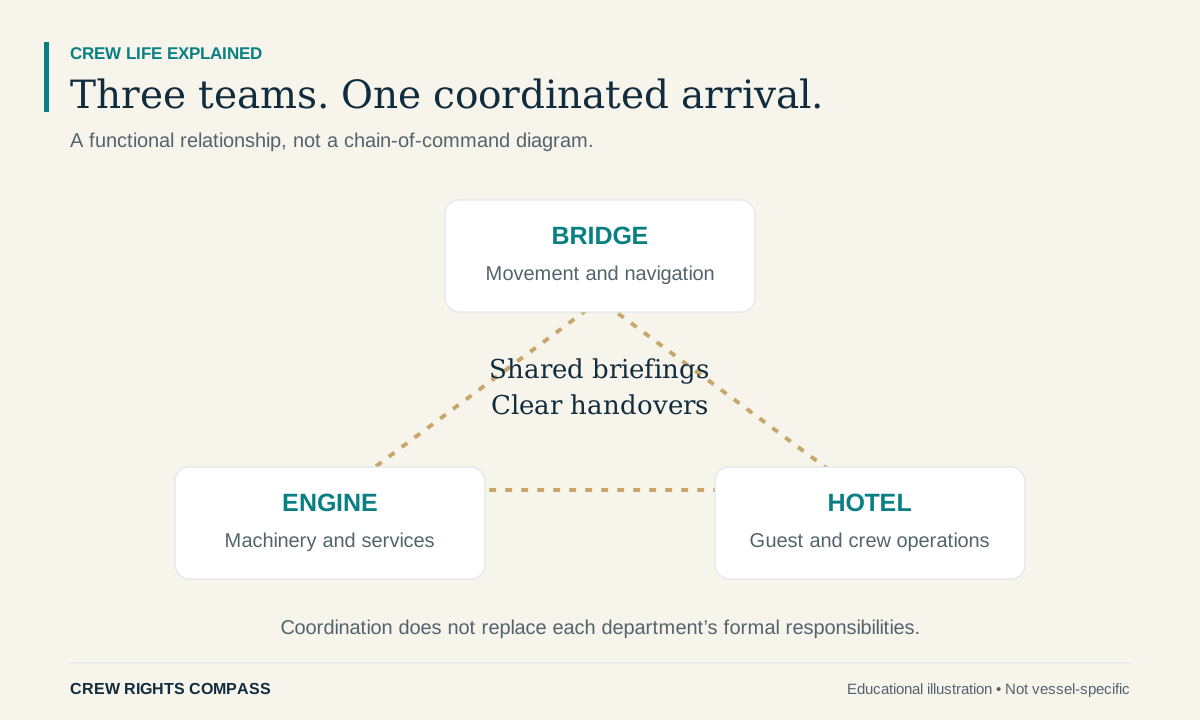
How the Bridge, Engine Room and Hotel Department Work Together
Navigation, technical systems and guest service meet in everyday decisions. Understanding the handovers helps you see how your own job fits into the whole ship.
Sources
- IMO Standard Marine Communication Phrases. Limited factual point: agreed standard language supports maritime safety communications; not used as a substitute for training
- Maersk cultural transformation and prevention at sea. Employer example of work on respectful culture, listening to seafarers and crew participation
Sources are references, not endorsements. Examples in this article are illustrative and do not describe a particular company, ship or person. Arrangements vary by employer and vessel: your own ship's instructions come first.
Spotted an error or an out-of-date source? Email a correction. Please do not send personal documents or evidence. See our editorial policy.