Professional Boundaries Onboard: Guests, Colleagues and Social Media
Workplace boundaries still matter when your workplace is also your home. Know the applicable policy, protect private information and make respectful choices online and off.
Saving is unavailable in this browser (its storage is turned off or full). Ordinary links and bookmarks still work.View saved
Working and living in the same place can blur the edges of a working day. Professional boundaries help keep those edges clear: who may enter a space, what information may be shared, and which relationships or requests require guidance from the company.
Find the policy before assuming the rule
Ask where to find the current conduct, guest-contact, cabin-access, gifts and social-media policies that apply to your role. Guest-area access itself may differ by position; one employer explicitly describes it as role-dependent. A colleague's permission does not automatically extend to you.
If a guest asks for a personal phone number, an off-duty meeting or a favour outside your duties, use a polite pause and check the relevant policy. You do not need to improvise an answer to avoid a moment of awkwardness.
Policies can differ, but respect does not depend on a job title. Do not pressure a colleague for personal contact, photographs or social participation, and accept a clear refusal without punishment or repeated requests.
Keep private material private
A photograph can reveal more than its subject: a cabin number, passenger name, screen, crew schedule or document may be visible in the background. Check the setting, obtain appropriate permission and follow company rules before taking or sharing an image.
Permission from one person does not authorise disclosure of everyone else's information. Avoid publishing patient details, private complaints, identification documents or images of colleagues in vulnerable situations. A closed social group is still a place where material can be copied.
For example, an illustrative crew member wants to share a cheerful team photograph. They first check that photography is permitted, that everyone agrees and that no confidential board is visible behind the group.
Address uncertainty early
Ask a supervisor or appropriate HR contact how to handle an uncertain boundary. Keep questions factual: what was requested, what policy applies and who should respond. Where the concern involves that person, use an alternative reporting route provided by the organisation.
Harassment, coercion and threats are not simply differences in social style. Seek appropriate support and reporting options; do not feel obliged to settle a serious concern through an informal conversation alone.
A useful pause: before accepting, entering, photographing or posting, ask whether you have the right permission and whether anyone's privacy or professional position could be affected.
Your next step
Read next
Life at sea
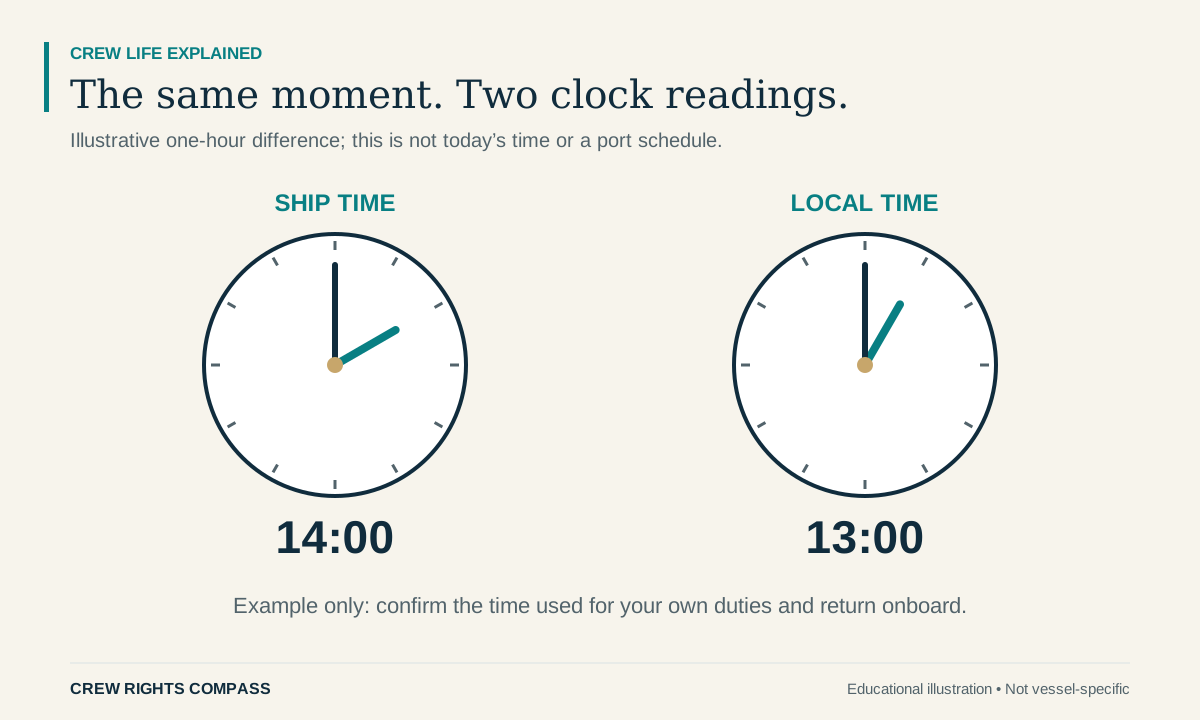
Ship Time vs Local Time: A Small Difference That Can Ruin Your Day
Your phone, the café clock and the ship may disagree. Learn how to confirm the time that controls your return and avoid an unnecessary race.
Life at sea
Sharing a Crew Cabin: Privacy, Sleep and Roommate Etiquette
Small spaces work better with clear agreements. Start a practical conversation about alarms, quiet time, cleaning, visitors and privacy before minor irritations become a routine.
Sources
- Royal Caribbean Group — Life at Sea. Employer-specific statement that access to guest areas depends on position; no universal policy on relationships, gifts or photographs is inferred
- IMO — Supporting seafarers. Official context on prevention of violence and harassment in the maritime sector
Sources are references, not endorsements. Examples in this article are illustrative and do not describe a particular company, ship or person. Arrangements vary by employer and vessel: your own ship's instructions come first.
Spotted an error or an out-of-date source? Email a correction. Please do not send personal documents or evidence. See our editorial policy.