Ship Time vs Local Time: A Small Difference That Can Ruin Your Day
Your phone, the café clock and the ship may disagree. Learn how to confirm the time that controls your return and avoid an unnecessary race.
Saving is unavailable in this browser (its storage is turned off or full). Ordinary links and bookmarks still work.View saved
Ship time is the time officially used onboard. Local time is the time used in the place you are visiting. They can differ, and your phone changing its clock does not change your ship’s instructions.
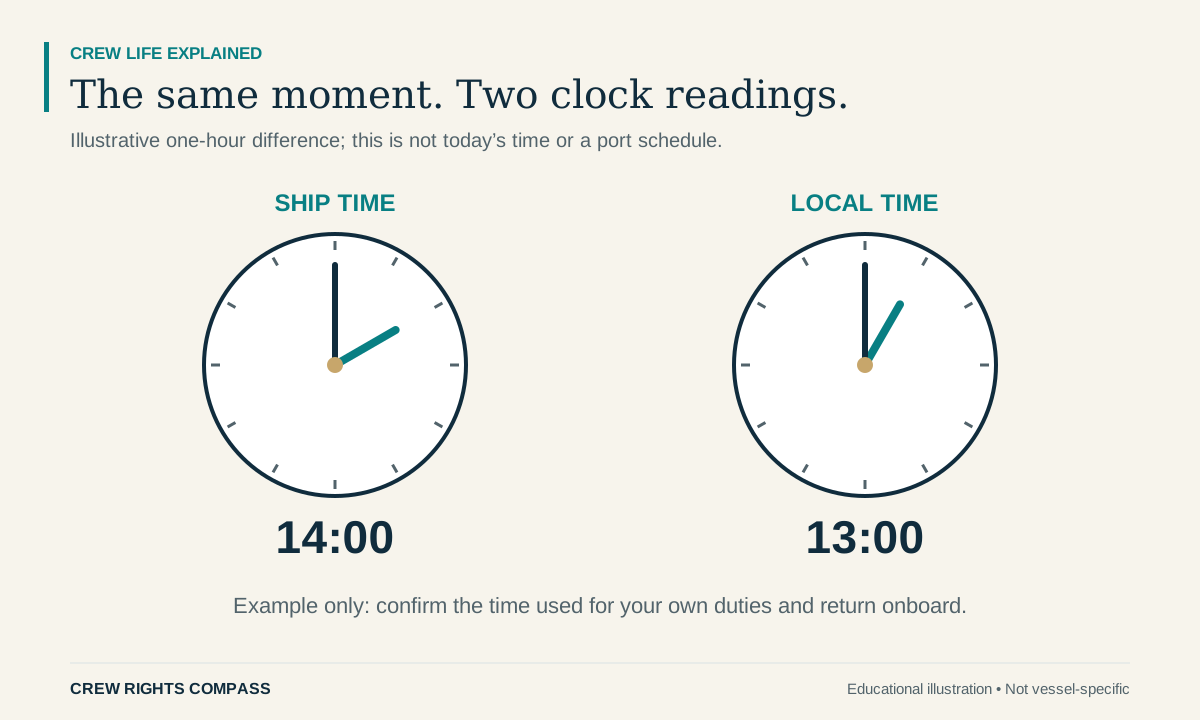
The same moment. Two clock readings.
- Ship time 14:00; local time 13:00.
- Illustrative one-hour difference; this is not today’s time or a port schedule.
- Example only: confirm the time used for your own duties and return onboard.
Educational illustration; arrangements vary by vessel. Open the full-size diagram: The same moment. Two clock readings.
Check the time that controls your day
Before going ashore, confirm the current ship time and your own required return time through the ship’s official information. Ask whether your duty, training or crew return deadline is earlier than the passenger all-aboard time.
Do not confuse departure time with the time you must be back. Royal Caribbean tells guests to verify all-aboard information onboard; crew must also check the instructions that apply to their work.
If you hear about a clock change, confirm when it takes effect and what it means for your next duty. A colleague remembering yesterday’s time difference is not enough.
Make the difference visible
Illustrative example: At one particular port, ship time is 14:00 while local time is 15:00. A return deadline of 16:00 ship time therefore corresponds to 17:00 local time. That example is arithmetic, not a rule for any destination. At another port, the difference could reverse or disappear.
Write both times with labels. “Return: 16:00 SHIP / 17:00 LOCAL” is harder to misread than “back at five.” Build in time for the actual journey, queues and any transfer from shore to ship; do not plan to arrive at the last minute.
A phone may update automatically when its network or location changes. Check how your device behaves. If you use a watch or a second clock for ship time, verify it against an authoritative onboard source after any announced change.
Check again before leaving the ship
Confirm three things: the correct time, the return deadline and the contact or procedure to use if something goes wrong ashore. Keep that information accessible without relying on mobile data.
If you are delayed, use the ship’s stated contact procedure promptly. Do not assume that a message means the ship can wait or that transport will automatically be arranged.
Takeaway: Label ship time and local time, verify your own deadline, and leave yourself a realistic return margin. A pretty harbour deserves your attention; your clock does too.
Quick check · no score kept
An illustrative example: your phone changes time ashore. Which time should you use for the crew return deadline?
- Whatever time the phone now shows
- The time basis confirmed in the ship’s current instructions
- The time a passenger remembers from yesterday
Show the explanation
The article’s answer: The time basis confirmed in the ship’s current instructions. Confirm the current ship instructions and your crew return deadline. A phone’s automatic change does not establish the time your ship is using. There is no universal one-hour difference.
Your next step
Read next
Life at sea
Shore Leave Planning: Ship Time, Transport and Getting Back Safely
Make a short visit ashore easier by confirming the return arrangements first, planning a realistic route and keeping essential contact information available offline.
Life at sea
Sharing a Crew Cabin: Privacy, Sleep and Roommate Etiquette
Small spaces work better with clear agreements. Start a practical conversation about alarms, quiet time, cleaning, visitors and privacy before minor irritations become a routine.
Sources
- Carnival: Everything I Did Wrong on My First Cruise. Cruise-line published example that ship time and local time are not always the same
- Royal Caribbean: Do I need to book a shore excursion?. Guest all-aboard time should be verified onboard; article distinguishes this from crew-specific requirements
- Carnival: How to Cruise Like a Pro. Phone clocks may change to local time; source is passenger guidance, not a crew deadline policy
Sources are references, not endorsements. Examples in this article are illustrative and do not describe a particular company, ship or person. Arrangements vary by employer and vessel: your own ship's instructions come first.
Spotted an error or an out-of-date source? Email a correction. Please do not send personal documents or evidence. See our editorial policy.