Shore Leave Planning: Ship Time, Transport and Getting Back Safely
Make a short visit ashore easier by confirming the return arrangements first, planning a realistic route and keeping essential contact information available offline.
Saving is unavailable in this browser (its storage is turned off or full). Ordinary links and bookmarks still work.View saved
Plan the return before planning the outing. A useful shore-leave plan starts with permission and current instructions, then works backwards from the crew return deadline using realistic transport and access arrangements.
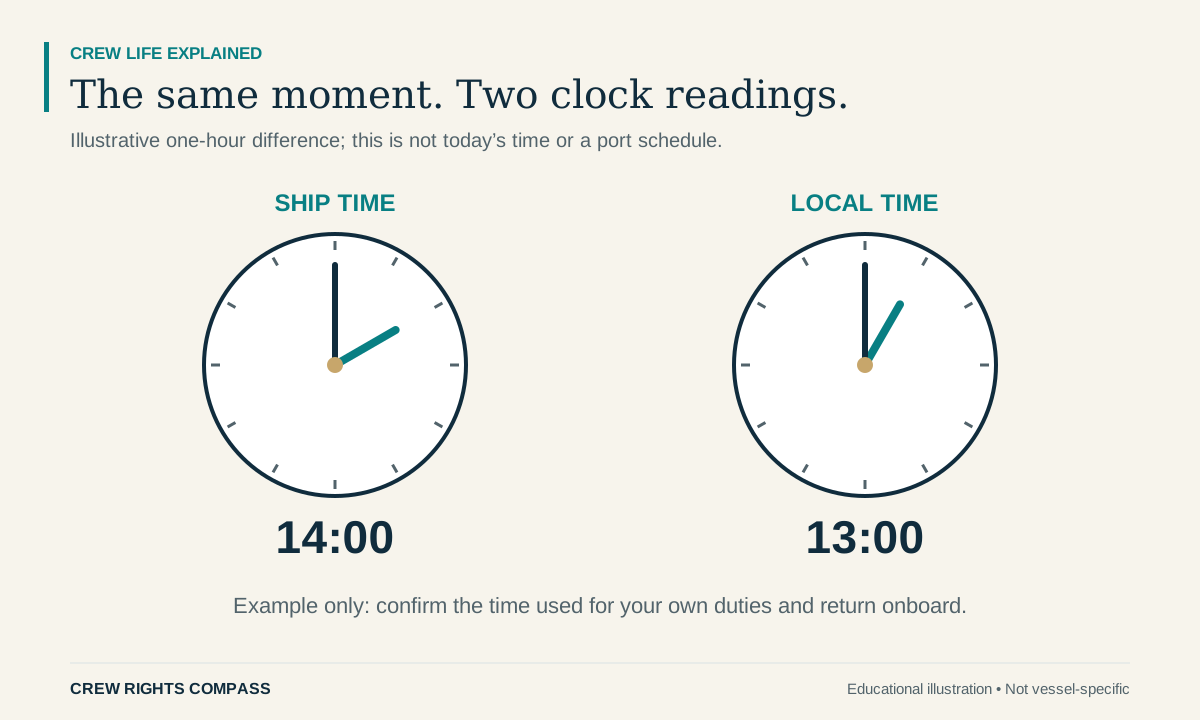
The same moment. Two clock readings.
- Ship time 14:00; local time 13:00.
- Illustrative one-hour difference; this is not today’s time or a port schedule.
- Example only: confirm the time used for your own duties and return onboard.
Educational illustration; arrangements vary by vessel. Open the full-size diagram: The same moment. Two clock readings.
Check the essentials before leaving
Confirm that you may go ashore, the applicable crew return time, the time standard being used, and whether you have any duty that affects the outing. Do not substitute the advertised sailing time or a passenger's instruction for the crew instruction.
Check the required identification and local entry arrangements through the ship's responsible team. Know the terminal, berth or tender return point, and save the approved ship or agent contact details offline. A street address is less useful if you do not know which port gate admits returning crew.
Shore access can be affected by port arrangements, immigration requirements and the ship's operational schedule. A port call does not automatically mean that every crew member can leave at any time.
Choose an outing with a realistic return
Look at both legs of the journey. Ask about the last permitted shuttle or tender, traffic, queues, payment methods and walking access. Build a sensible buffer for the actual circumstances; a fixed number of spare minutes cannot suit every port.
For illustration, a café near the authorised shuttle stop may make more sense than a distant attraction when the available window is short. An attractive itinerary is not useful if its return depends on every connection working perfectly.
Use reputable transport and follow local safety guidance. Keep your belongings secure and avoid letting a social plan pressure you into an unfamiliar or unsuitable arrangement. If plans change, choose the simpler route back.
Keep the plan available when the phone is not
Save the terminal name, return point and essential contacts somewhere you can use without a data connection. Check the time before setting a reminder; phones may update automatically to local time while ship instructions use a different clock.
If an unexpected delay threatens your return, contact the ship through the approved route promptly and follow its instructions. Do not assume that another crew member will report your situation.
Before the gangway: know when to return, which clock governs that time, where to return and how to contact the ship. Then enjoy the time you actually have.
Your next step
Read next
Life at sea
Ship Time vs Local Time: A Small Difference That Can Ruin Your Day
Your phone, the café clock and the ship may disagree. Learn how to confirm the time that controls your return and avoid an unnecessary race.
Life at sea
Sharing a Crew Cabin: Privacy, Sleep and Roommate Etiquette
Small spaces work better with clear agreements. Start a practical conversation about alarms, quiet time, cleaning, visitors and privacy before minor irritations become a routine.
Sources
- The Mission to Seafarers — Setting foot on foreign soil. Context on operational and port factors affecting shore access; article does not attempt a jurisdiction-specific legal entitlement assessment
Sources are references, not endorsements. Examples in this article are illustrative and do not describe a particular company, ship or person. Arrangements vary by employer and vessel: your own ship's instructions come first.
Spotted an error or an out-of-date source? Email a correction. Please do not send personal documents or evidence. See our editorial policy.