Chief Engineer vs Chief Officer: Two Different Responsibilities
The chief engineer and chief officer lead different parts of ship operations. Learn the distinction, why cruise titles vary and how departments coordinate their work.
Saving is unavailable in this browser (its storage is turned off or full). Ordinary links and bookmarks still work.View saved
The chief engineer leads the engineering side of a ship; the chief officer is a senior deck officer. They are different professional roles, not two names for the same job. Cruise ships can also have a staff captain and several specialised senior positions, so the company chart matters.
What each role looks after
The chief engineer's central responsibility is the ship's propulsion and the operation and maintenance of its mechanical and electrical installations. Work is delivered through engineering officers, ratings and relevant specialists, rather than one person personally repairing everything.
On a conventional merchant-ship organisation chart, the chief officer, or chief mate, leads the deck department. Responsibilities can include cargo, stability, deck maintenance and safety work. Passenger ships divide these functions differently; the person called chief officer is not automatically the second-in-command on every cruise ship.
IMO training material presents a typical departmental structure and explicitly recognises variation between ship types. Treat diagrams on careers blogs as orientation, not as the command structure of your next vessel.
A ship needs both departments talking
Consider a planned maintenance job that affects equipment needed for a port arrival. The engineering team needs a workable maintenance window; deck colleagues need to understand the operational effect. A good handover identifies the equipment, restrictions, responsible person and confirmation that work is complete.
That is an illustrative coordination problem, not an instruction to operate equipment. Actual permissions and communication follow the vessel's safety management system.
If you are joining in a hotel role, you do not need to memorise every officer's technical duties. You do need to know your own supervisor, the urgent reporting route and how to describe a defect clearly. Location, time and what you observed are more useful than guessing which department caused it.
Ask for the real organisation chart
Before accepting a technical role, ask:
- Which equipment or duties are assigned to this position?
- Who is the direct supervisor, and who covers when they are unavailable?
- What watch pattern, handover and familiarisation apply?
- Which certificates and flag-state endorsements are required?
- How are defects, work orders and unresolved safety concerns escalated?
For career planning, compare the deck and engineering training routes with an approved provider. Choose the work that interests you, rather than choosing a title because it sounds more senior.
Your next step
Read next
Roles onboard
Cruise Ship Ranks and Hierarchy Explained: Who Reports to Whom?
Understand the main onboard teams, find your reporting line and learn why your everyday supervisor may be different from the person directing an emergency.
Roles onboard
Cruise Ship Departments Explained: Finding the Right Role for You
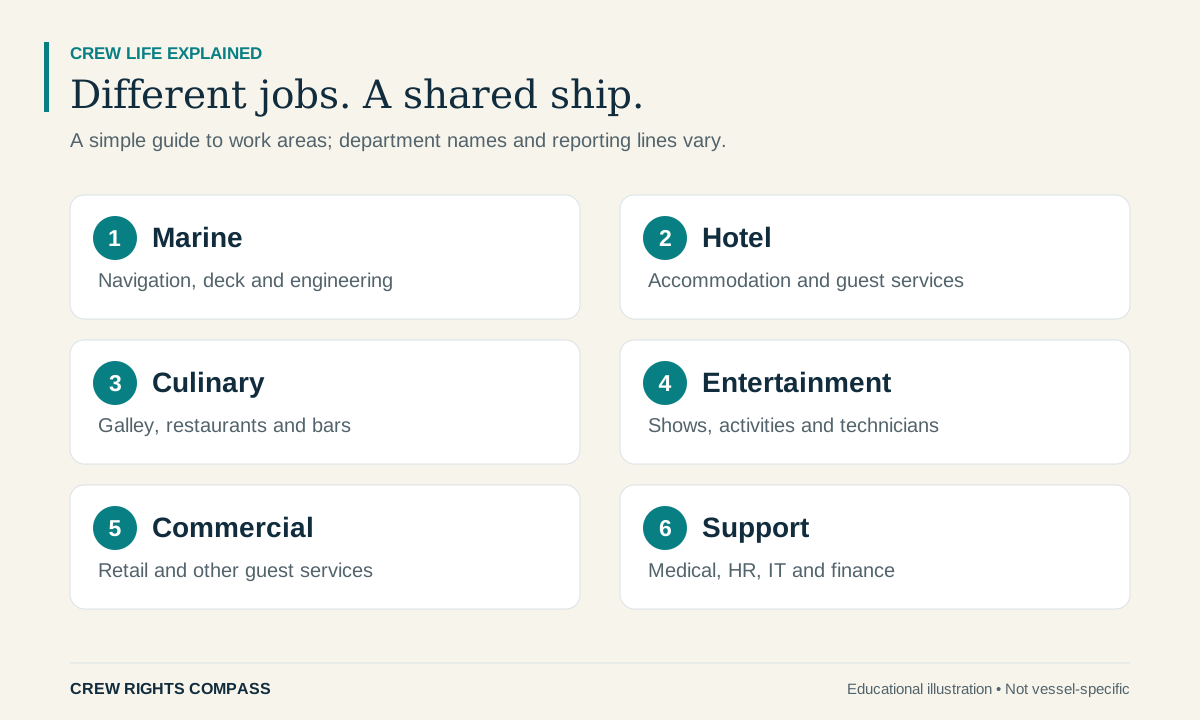
From navigation and engineering to hospitality, entertainment and medical work, compare the main onboard teams by their work rather than the glamour of a title.
Sources
- IMO: STCW Conference resolution 1. Formal chief engineer and chief mate definitions; distinction from company-specific titles
- IMO: Ship-board energy management training module. Typical deck/engine division, departmental duties and variation between ships
Sources are references, not endorsements. Examples in this article are illustrative and do not describe a particular company, ship or person. Arrangements vary by employer and vessel: your own ship's instructions come first.
Spotted an error or an out-of-date source? Email a correction. Please do not send personal documents or evidence. See our editorial policy.