Cruise Ship Departments Explained: Finding the Right Role for You
From navigation and engineering to hospitality, entertainment and medical work, compare the main onboard teams by their work rather than the glamour of a title.
Saving is unavailable in this browser (its storage is turned off or full). Ordinary links and bookmarks still work.View saved
Cruise ships employ much more than sailors and waiters. The useful question is which department matches your actual skills, preferred tasks and qualifications. Department names vary, so read the vacancy itself rather than relying on a job-title list.
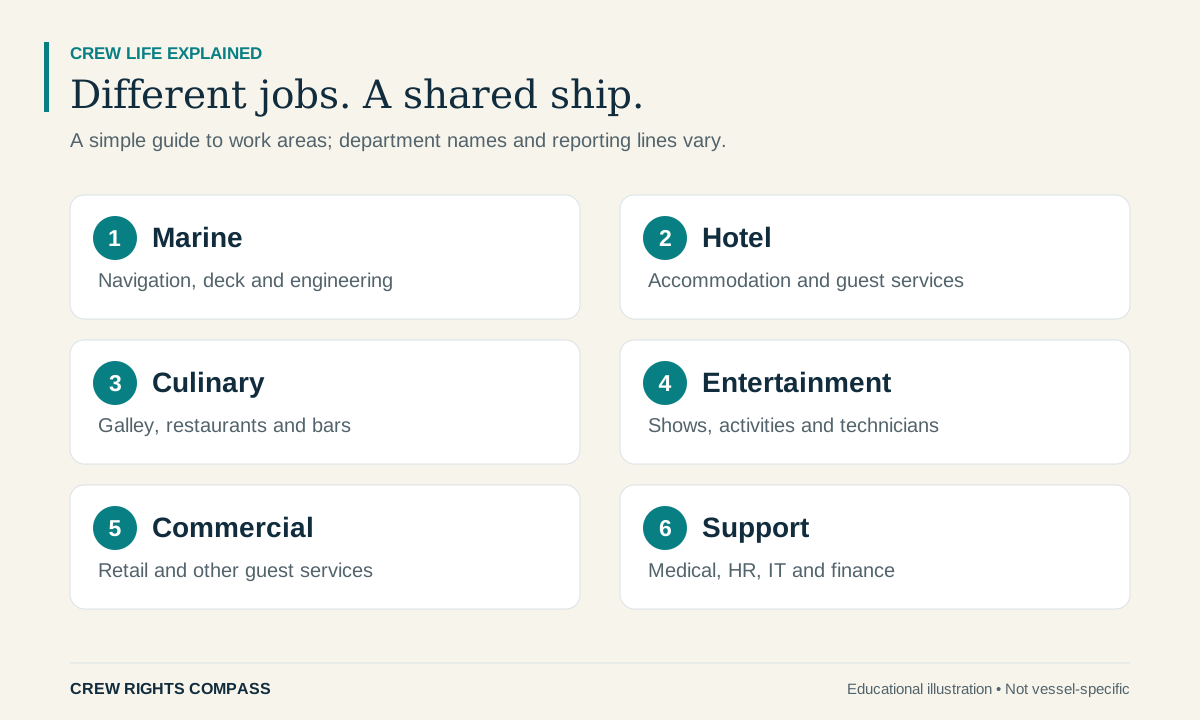
Different jobs. A shared ship.
- A simple guide to work areas; department names and reporting lines vary.
- 1. Marine: navigation, deck and engineering.
- 2. Hotel: accommodation and guest services.
- 3. Culinary: galley, restaurants and bars.
- 4. Entertainment: shows, activities and technicians.
- 5. Commercial: retail and other guest services.
- 6. Support: medical, HR, IT and finance.
Educational illustration; arrangements vary by vessel. Open the full-size diagram: Different jobs. A shared ship.
Start with the work
Deck and marine operations: Navigation, watchkeeping and deck-related operations. Different positions have different training and certification requirements.
Engineering and technical: Machinery, electrical systems and technical maintenance. Some roles support equipment in hotel areas as well as operational spaces.
Hotel and hospitality: Guest services, housekeeping, laundry, food preparation and food or beverage service. These contain many different roles, not one interchangeable “hotel job.”
Entertainment and recreation: Performances, production, activities and youth or sports programmes, depending on the ship.
Retail and other commercial services: Shops, photography, spa or similar services may involve specialist operators. Check which company would employ you.
Professional and support functions: Medical, human resources, finance, IT and inventory roles support people and operations behind the scenes.
Job titles can hide the interesting part
A role’s work location does not always tell you its reporting department. Carnival’s Hotel Service Technician description, for example, places the role in the engine team while working with hotel managers. That is why the full description matters.
Illustrative example: Two applicants both enjoy fixing equipment. One is interested in sound and lighting for performances; the other has experience maintaining electrical systems. “Technical work” does not make their qualifications, responsibilities or reporting lines the same.
Choose two or three actual vacancies and compare the daily tasks. Highlight what you can already demonstrate, what requires formal credentials and what you would need to learn. A dream role becomes more useful when you can name the gap.
Ask questions before applying
Find out who the employer is, who supervises the position, what credentials are required and how the selection process works. Ask about the published contract arrangements instead of assuming that one department always receives a particular cabin or schedule.
Use official employer careers pages and keep a copy of the vacancy you apply for. Job descriptions can change or disappear.
Takeaway: Pick a role by its duties and requirements. Then research the employer and contract. The best department is the one whose real work fits you.
Your next step
Sources
- Royal Caribbean Group: Ship careers. Examples of the range of onboard functions, including marine, hospitality, entertainment and support
- Carnival: Hotel Service Technician. Specific example of a technical role in the engine team working with hotel management
- MSC Cruise Division: Onboard roles. Examples of roles across marine and guest operations; no universal requirements inferred
Sources are references, not endorsements. Examples in this article are illustrative and do not describe a particular company, ship or person. Arrangements vary by employer and vessel: your own ship's instructions come first.
Spotted an error or an out-of-date source? Email a correction. Please do not send personal documents or evidence. See our editorial policy.