Cruise Ship Ranks and Hierarchy Explained: Who Reports to Whom?
Understand the main onboard teams, find your reporting line and learn why your everyday supervisor may be different from the person directing an emergency.
Saving is unavailable in this browser (its storage is turned off or full). Ordinary links and bookmarks still work.View saved
A cruise ship has several connected reporting lines. The captain, also called the master, leads the ship, but most everyday decisions move through departmental supervisors. Learn your own reporting line before trying to memorise every stripe.
Three useful starting points
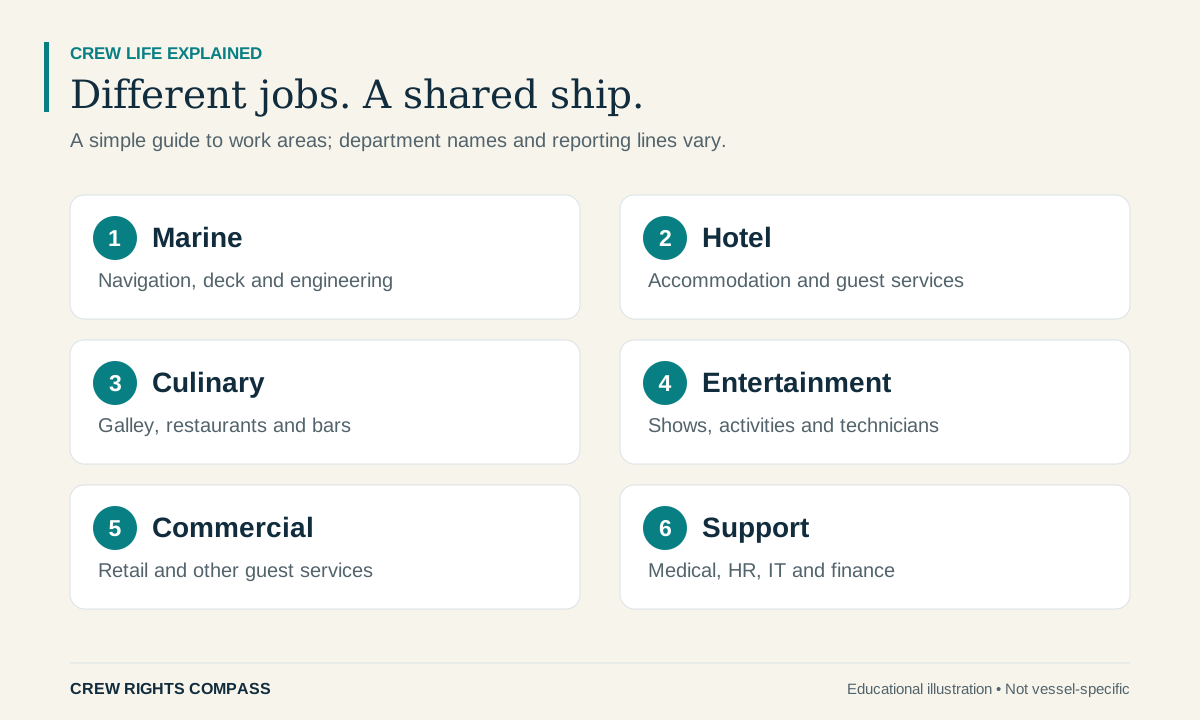
Think in broad groups: deck, technical and hotel or guest operations. Deck teams handle navigation and associated ship operations. Technical teams look after machinery and systems. Hotel teams deliver accommodation, food, entertainment and other guest services.
The exact organisation varies. Some functions sit in separate departments; concession businesses may employ their own people. Titles such as staff captain, chief officer, hotel director and general manager are not interchangeable across every fleet.
The master’s overall safety and security responsibility does not mean that every payroll query or broken locker goes directly to the captain. An organisation chart is useful because it connects a problem to the person who can actually address it.
Learn your own chain first
Ask for four names or contacts: your immediate supervisor, department head, crew administration contact and the appropriate safety contact. Find out who covers each role when that person is unavailable.
Then check how to report something urgent, how to raise an employment concern and where to seek help if your concern involves your supervisor. These may use different channels. Do not assume a normal reporting line is the only permitted route for a sensitive complaint.
Illustrative example: A restaurant employee notices their cabin door will not lock. Their restaurant supervisor may help identify the correct maintenance or accommodation reporting route; they should not have to guess which uniformed officer repairs doors. If the situation creates an immediate security concern, the ship’s urgent reporting procedure matters too.
Emergency roles are a separate map
Your daily job title does not tell you your emergency assignment. A person working in hospitality may also have an assigned passenger safety duty after the appropriate training.
Read your own assignment and attend the ship’s familiarisation. Never substitute an internet rank chart for onboard instructions.
Takeaway: Save your actual reporting contacts, ask how to escalate a concern and keep your emergency instructions accessible. Knowing whom to ask is more useful than judging authority by stripes alone.
Your next step
Read next
Roles onboard
Crew, Staff and Officers: What Do These Labels Actually Mean?
Onboard labels can describe employment groups, professional roles or everyday conversation. Learn what to ask before assuming a title guarantees authority, benefits or a particular cabin.
Roles onboard
Cruise Ship Departments Explained: Finding the Right Role for You
From navigation and engineering to hospitality, entertainment and medical work, compare the main onboard teams by their work rather than the glamour of a title.
Sources
- IMO: Frequently Asked Questions on Maritime Security. Master’s ultimate responsibility for ship safety and security
- Royal Caribbean Group: Ship careers. Examples of marine, hotel and supporting shipboard functions; not a universal organisation chart
- IMO: Passenger ships. Passenger ship personnel may require training specific to assigned safety responsibilities
Sources are references, not endorsements. Examples in this article are illustrative and do not describe a particular company, ship or person. Arrangements vary by employer and vessel: your own ship's instructions come first.
Spotted an error or an out-of-date source? Email a correction. Please do not send personal documents or evidence. See our editorial policy.