Crew, Staff and Officers: What Do These Labels Actually Mean?
Onboard labels can describe employment groups, professional roles or everyday conversation. Learn what to ask before assuming a title guarantees authority, benefits or a particular cabin.
Saving is unavailable in this browser (its storage is turned off or full). Ordinary links and bookmarks still work.View saved
“Crew,” “staff” and “officer” do not form one universal cruise-industry classification. Their meaning depends on the conversation, company and role. Ask what a label means on your ship before using it to predict someone’s responsibilities or benefits.
One word can do more than one job
Crew can describe the people working aboard collectively. In some company conversations, it may also name a narrower employment or accommodation group. Those are different uses of the same word.
Staff is an ordinary employment word that some cruise businesses use as an internal category. It does not, by itself, tell you the person’s qualifications, emergency assignment or contract terms.
Officer can identify a professional deck or engineering role. It can also appear in other company job titles. Read the role and required credentials; the title alone does not establish a person’s qualification to navigate or operate a ship.
The IMO’s STCW framework addresses training, certification and watchkeeping standards. That professional framework should not be confused with an employer’s social or accommodation labels.
Ask about the arrangement, not the status
If someone says a job has “staff privileges,” ask what that means in writing: accommodation, dining access, permitted areas and any conditions. A recruitment video or another person’s previous contract is not a reliable description of your offer.
Find out the employing company and reporting line too. A person working in a commercial service onboard may have arrangements different from the cruise line’s direct employees.
Illustrative example: Two people introduce themselves as officers. One is a navigation officer; another has an administrative officer title. They may have different professional requirements and decision-making responsibilities. Neither title tells you who handles your particular concern without more information.
Keep respect independent of labels
A workplace needs defined responsibilities. It does not need an assumption that one dining room, uniform or job title measures someone’s value.
For your own decisions, use the documents that answer the question: the job description for duties, the contract and applicable rules for employment terms, and onboard instructions for emergency responsibilities. A casual status label cannot replace any of them.
Takeaway: When someone mentions crew, staff or officer status, ask, “What does that mean for this role on this ship?” Specific answers are more useful than a supposed universal hierarchy.
Your next step
Read next
Roles onboard
Cruise Ship Ranks and Hierarchy Explained: Who Reports to Whom?
Understand the main onboard teams, find your reporting line and learn why your everyday supervisor may be different from the person directing an emergency.
Roles onboard
Cruise Ship Departments Explained: Finding the Right Role for You
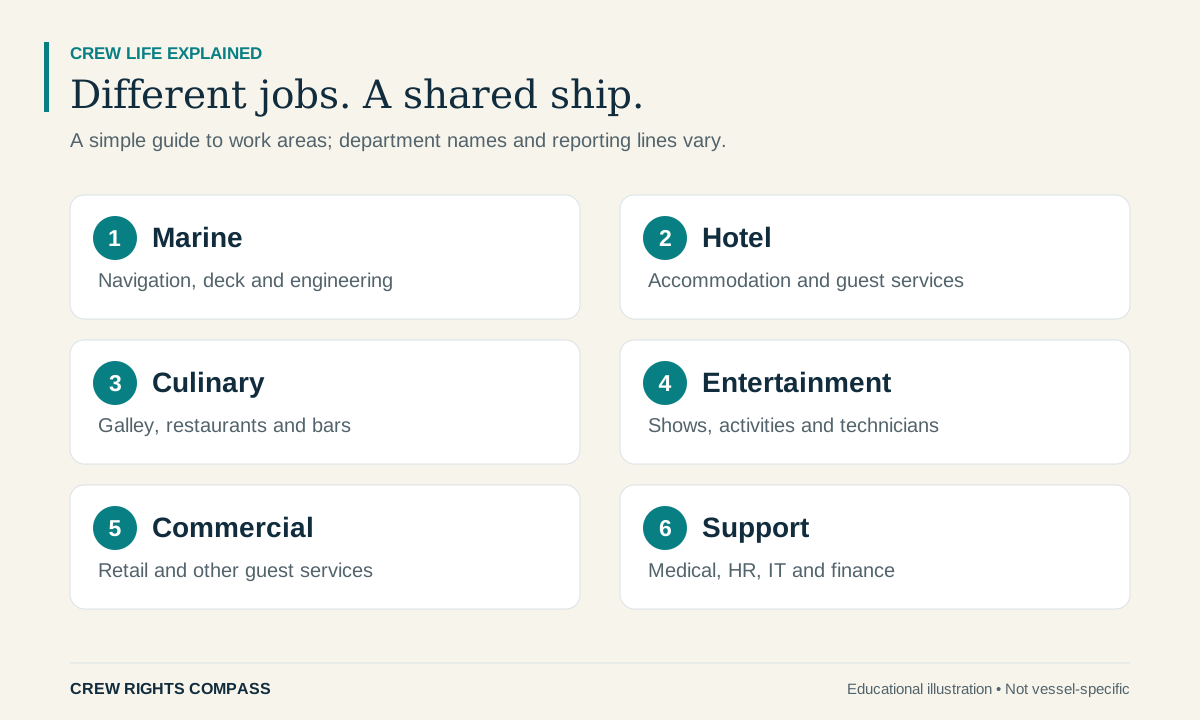
From navigation and engineering to hospitality, entertainment and medical work, compare the main onboard teams by their work rather than the glamour of a title.
Sources
- IMO: STCW Convention. STCW concerns seafarer training, certification and watchkeeping; distinct from informal company status labels
- MSC Cruise Division: Onboard job search. Employer example using officers and staff in an accommodation-related role description, without defining a universal status system
- Royal Caribbean Group: Life at Sea. Employer accommodation and onboard arrangements depend on role; not a cross-industry entitlement table
Sources are references, not endorsements. Examples in this article are illustrative and do not describe a particular company, ship or person. Arrangements vary by employer and vessel: your own ship's instructions come first.
Spotted an error or an out-of-date source? Email a correction. Please do not send personal documents or evidence. See our editorial policy.