Who Is in Charge When a Harbour Pilot Boards?
A pilot brings local navigational expertise. The master and bridge team still have responsibilities, while local law can determine exactly how pilotage authority works.
Saving is unavailable in this browser (its storage is turned off or full). Ordinary links and bookmarks still work.View saved
A harbour pilot brings specialist local knowledge, but boarding the ship does not simply make the captain’s responsibilities disappear. Pilotage involves cooperation between the pilot, master and bridge team. The exact legal allocation of authority depends on the jurisdiction and the applicable pilotage regime.
That qualification matters. “The pilot takes over everything” and “the pilot is only a visitor offering suggestions” are both poor explanations of a relationship that carries real duties.
Local knowledge meets ship knowledge
IMO describes pilotage as using local expertise to help ships navigate ports and other waters where that knowledge is needed. The ship’s team brings knowledge of its own vessel, equipment and condition.
IMO Resolution A.960(23) says that a pilot’s presence does not remove the master’s or navigational watch officer’s safety duties. It also emphasises clear roles and effective communication among the pilot, master and bridge personnel.
These are complementary responsibilities, not a contest over whose knowledge matters more. The work depends on information being exchanged and understood.
Why the legal wording matters
A pilot can have a defined legal role in the conduct of a ship. For example, guidance from Canada’s Laurentian Pilotage Authority explains a statutory framework for conduct in compulsory pilotage areas. That example should not be copied into a claim about every country or waterway.
Think of the relationship as two sources of expertise meeting at an important handover: detailed local knowledge and detailed vessel knowledge. The analogy explains cooperation; it is not a legal description of command.
If you need an answer for an investigation, dispute or training assessment, use the current law and official guidance for the actual location. A general blog cannot settle liability.
What this means for other crew
For crew outside the bridge team, pilotage can be a period of focused operational work. Follow your assigned duties and the vessel’s access and communication arrangements. Do not assume a pilot’s arrival changes your supervisor, reporting route or permission to enter an operational area.
If you are curious about roles, ask during an appropriate training or briefing session rather than interrupting an operation.
Takeaway: A pilot adds local expertise to a working bridge team. Responsibilities remain, and the details of legal authority require a location-specific answer.
Your next step
Read next
How ships work
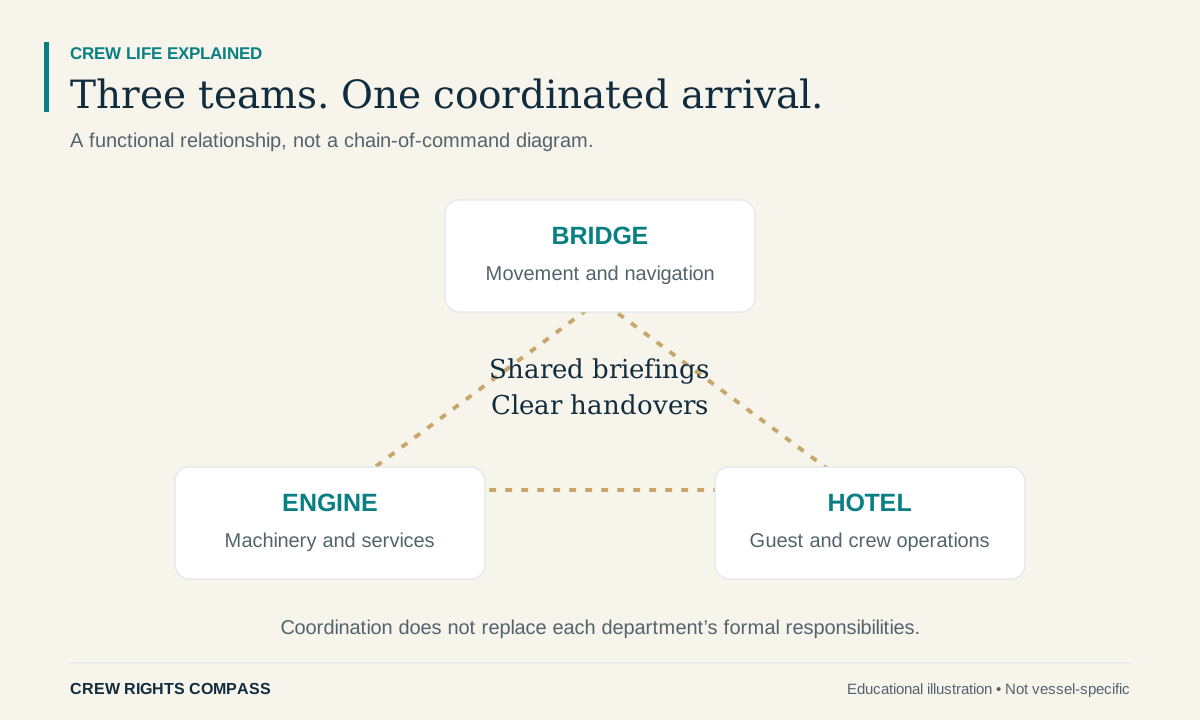
How the Bridge, Engine Room and Hotel Department Work Together
Navigation, technical systems and guest service meet in everyday decisions. Understanding the handovers helps you see how your own job fits into the whole ship.
How ships work
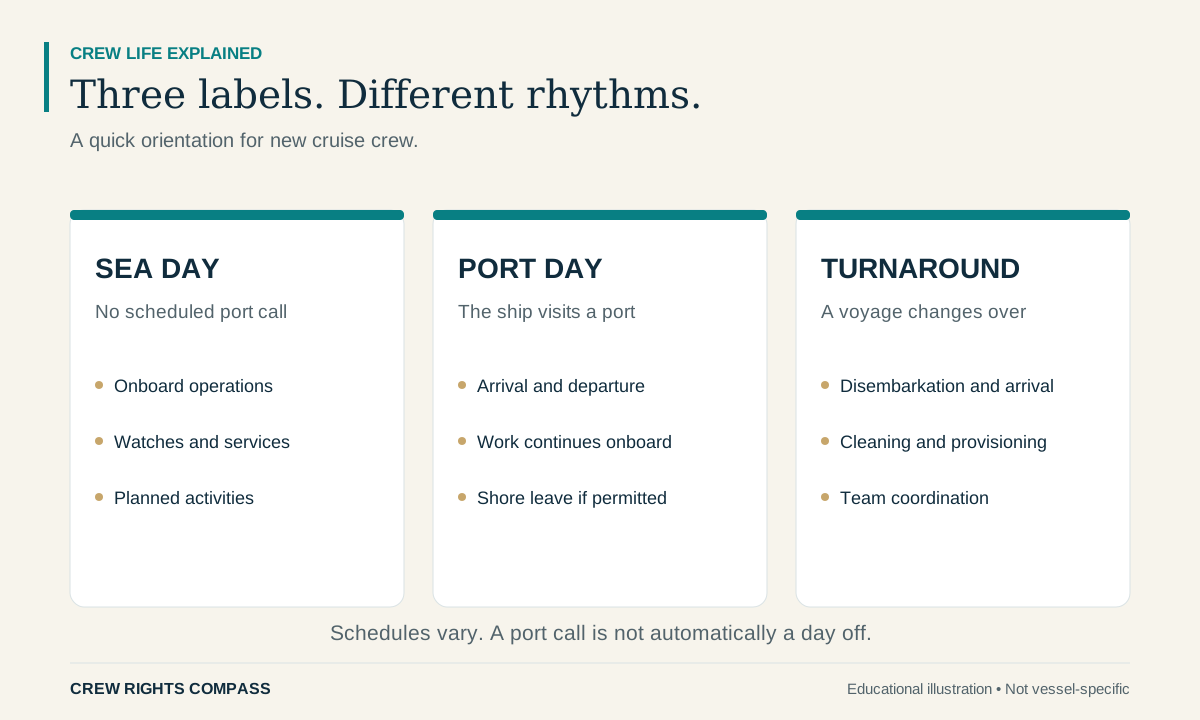
Why Turnaround Day Can Feel Like Three Days in One
One voyage ends while another begins. Follow the overlapping work behind luggage, cabins, supplies and boarding—and learn why small updates can have large effects.
Sources
- IMO Pilotage. Purpose and local-expertise role of maritime pilots
- IMO Resolution A.960(23). Annex 2: continuing safety duties, understanding roles and communication among pilot, master and bridge personnel
- Laurentian Pilotage Authority: General Information on Pilotage. Canadian example showing that conduct of a vessel is defined in a jurisdiction-specific legal framework; not presented as universal
Sources are references, not endorsements. Examples in this article are illustrative and do not describe a particular company, ship or person. Arrangements vary by employer and vessel: your own ship's instructions come first.
Spotted an error or an out-of-date source? Email a correction. Please do not send personal documents or evidence. See our editorial policy.