Port, Starboard, Forward and Aft: Find Your Bearings
Your left changes when you turn around. The ship’s port side does not. Learn the fixed reference points that make onboard directions easier to understand.
Saving is unavailable in this browser (its storage is turned off or full). Ordinary links and bookmarks still work.View saved
Face the bow, the front of the ship: port is on your left and starboard is on your right. Those are the ship's fixed sides. Turn yourself around and they stay where they were.
That small distinction makes directions far more useful when two people are facing opposite ways.
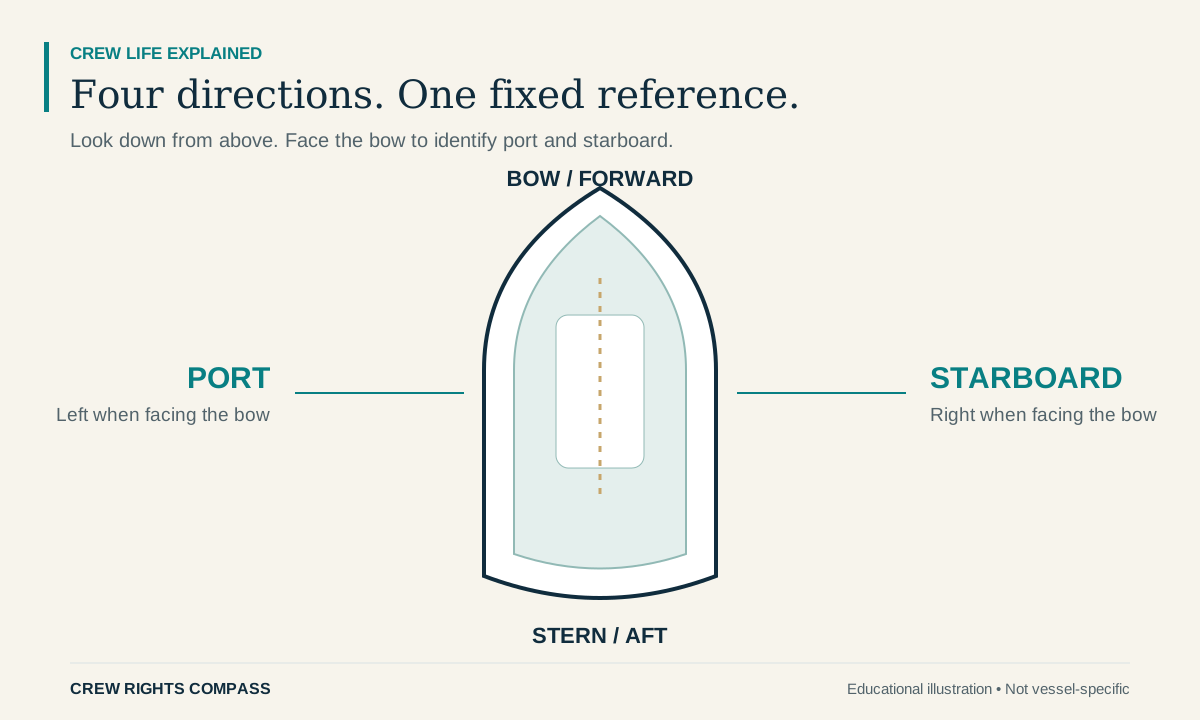
Four directions. One fixed reference.
- Look down from above. Face the bow to identify port and starboard.
- Port: left when facing the bow.
- Starboard: right when facing the bow.
- Bow / forward at one end; stern / aft at the other.
Educational illustration; arrangements vary by vessel. Open the full-size diagram: Four directions. One fixed reference.
Start with the ship's frame
The bow is the forward end; the stern is the rear end. Forward points towards the bow, while aft points towards the stern. Amidships refers to the middle region.
Here is a useful memory aid: “port” and “left” each have four letters. Remember the condition attached to it: you are looking towards the bow.
Port and starboard are not compass directions. The ship can change heading without changing the names of its sides. Also, “port” can mean a harbour or destination in other contexts. The sentence tells you which meaning is intended.
Try the turn-around test
Picture a simple overhead drawing of a vessel, with its bow at the top. Mark port on the left and starboard on the right.
Now imagine standing on that drawing facing the stern. Starboard is beside your left hand, but it remains starboard. Only your viewing direction changed.
This is a quiet practice exercise, not something to attempt while moving through a busy work area. A diagram is enough. If you get it wrong the first time, turn the imaginary person again, not the ship's labels.
Add the missing location details
“Meet me aft” can still leave a lot of ship to search. Ask for the deck, named space and authorised access route. A department's familiar nickname may not appear on signage.
For an everyday, fictional example, “the meeting room on Deck 4, port side” gives more information than “the room on the left.” You may still need to ask which meeting room.
During familiarisation, connect the words to places you are permitted to use: your accommodation area, work area and dining area. Follow posted access restrictions; a direction is not permission to enter.
Emergency movement follows your vessel's training, signs and instructions, rather than a shortcut inferred from this article.
Quick check: if you are facing the stern, does port change sides on the ship? No. That is the idea to carry into your next conversation.
Quick check · no score kept
In a top-down diagram, you are facing the bow. Which side is port?
- Left
- Right
- It changes with the direction you walk
Show the explanation
The article’s answer: Left. Port is the ship’s left side when facing the bow. Turning yourself around does not change the ship’s port side.
Your next step
Read next
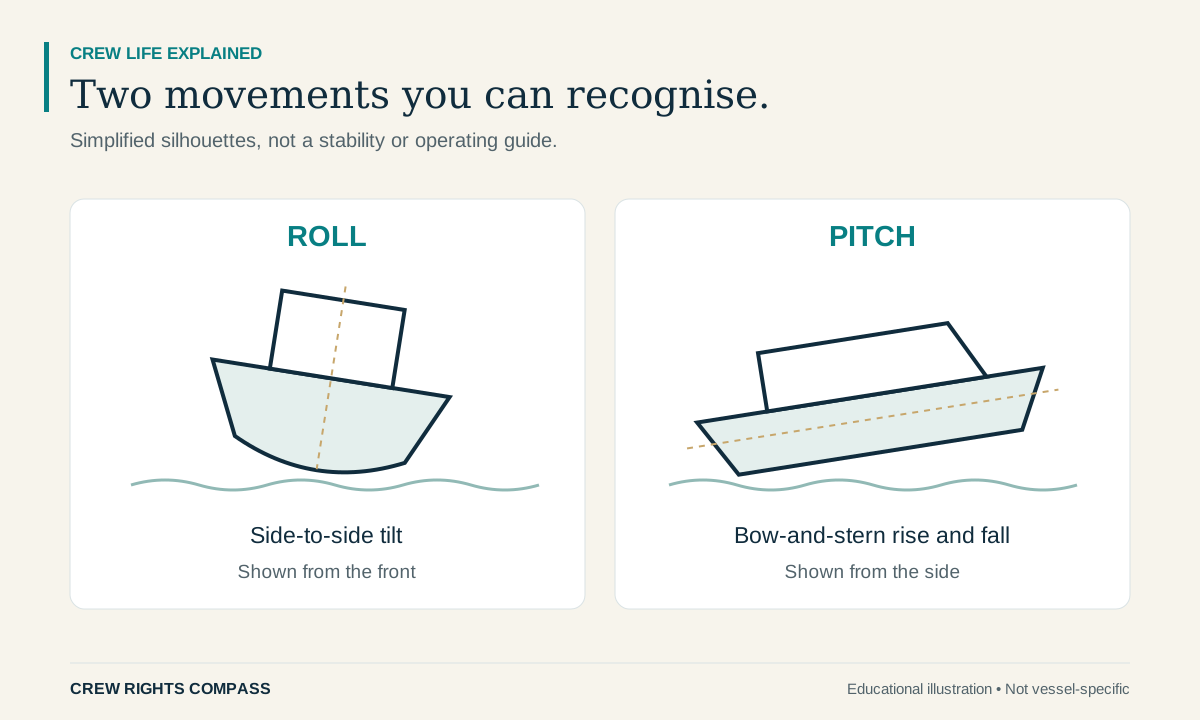
How ships work
Why Ships Roll, Pitch and Vibrate: A Beginner’s Guide
Side-to-side movement, bow-to-stern movement and a vibrating deck are different things. Learn the basic vocabulary without turning a sensation into a technical diagnosis.
Crew language
Cruise Ship Crew Slang: 50 Words You’ll Hear Onboard
Decode directions, work routines and casual crew conversation with a pocket glossary that separates useful maritime terms from informal expressions and company jargon.
Sources
- NOAA: Why do ships use port and starboard?. Fixed vessel sides and orientation looking towards the bow
- IMO Standard Marine Communication Phrases. Use of forward, aft and amidships as vessel-relative locations
Sources are references, not endorsements. Examples in this article are illustrative and do not describe a particular company, ship or person. Arrangements vary by employer and vessel: your own ship's instructions come first.
Spotted an error or an out-of-date source? Email a correction. Please do not send personal documents or evidence. See our editorial policy.