Turnaround, Sea Day and Port Day: The Crew Version
Cruise itineraries describe where the ship goes. Your work schedule describes what you do. Learn how these three day types fit together without confusing them.
Saving is unavailable in this browser (its storage is turned off or full). Ordinary links and bookmarks still work.View saved
A sea day usually means a cruise day without a port call. A port day includes a port visit. A turnaround marks the change between voyages, when one group of guests leaves and another joins. None of these labels tells you your hours of work.
For crew, the useful question is what that itinerary means for your particular department and assignment.
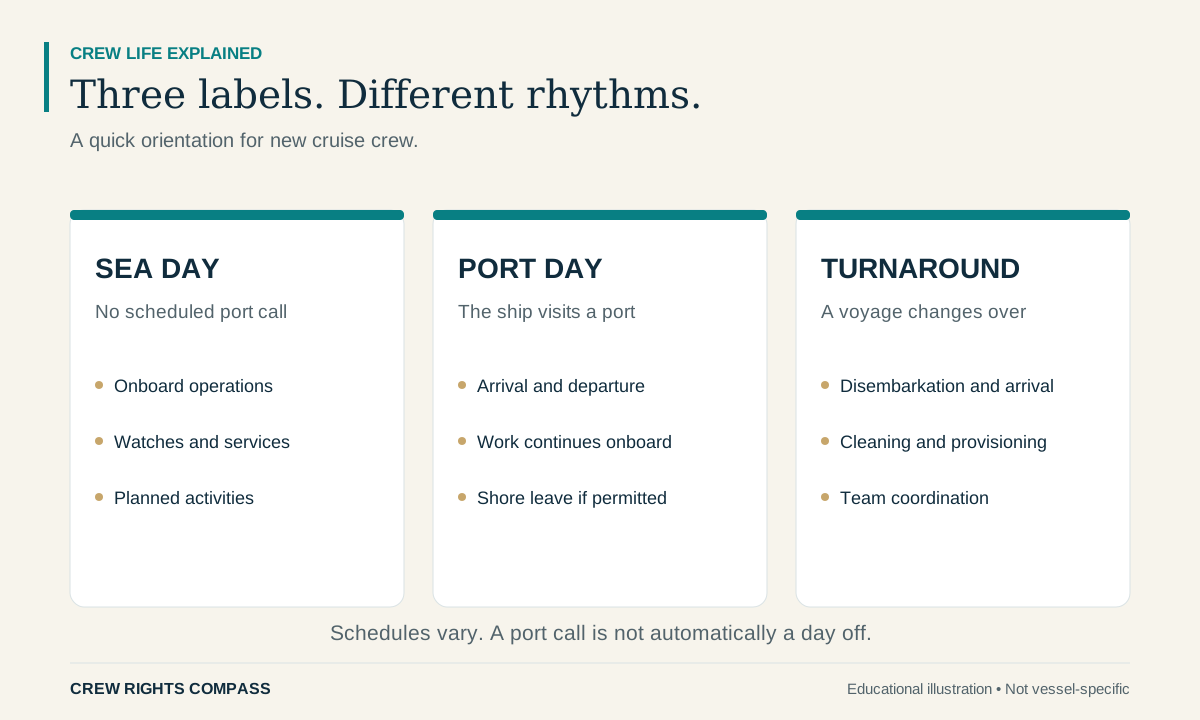
Three labels. Different rhythms.
- Sea day: no scheduled port call; onboard operations, watches and services, planned activities.
- Port day: the ship visits a port; arrival and departure, work continues onboard, shore leave if permitted.
- Turnaround: a voyage changes over; disembarkation and arrival, cleaning and provisioning, team coordination.
- Schedules vary. A port call is not automatically a day off.
Educational illustration; arrangements vary by vessel. Open the full-size diagram: Three labels. Different rhythms.
Turnaround: several teams, one changing ship
A turnaround can bring guest departures and arrivals, cleaning, baggage movement, provisioning and other work into the same period. The Port of Seattle describes its home-port calls as busy turnarounds involving disembarkation, loading and embarkation.
Your task is to understand your part, not guess everyone else's. Confirm your briefing time, work location, supervisor and handover arrangements. If another team depends on your completion, ask how they will be notified.
“Turnaround day” is context. Your roster and instructions provide the actual assignment.
Sea day and port day: different demand
On a sea day, guests remain aboard between destinations, so passenger-facing activity may be concentrated onboard. On a port day, some guests go ashore while others stay. Services, technical work and shipboard responsibilities continue.
Which day feels busier depends on the role and the voyage. Avoid promising a new colleague that every port day is quiet or that every sea day follows one pattern.
A fictional example: a guest plans an afternoon excursion, while a crew member has a duty period at the same time. The destination is shared; the available afternoon is not.
Plan from the latest instructions
Before arranging time ashore, check your duties, required attendance, permission arrangements and the crew return deadline. Port access and immigration requirements can also affect what is possible.
Confirm the time reference being used. Do not assume your phone's automatically updated local time matches the ship's announced time. Ask if the information is unclear.
Keep a small daily note:
- Today's duty and briefing times.
- Any drill or required appointment.
- Whether time ashore is available to you.
- The current crew return deadline and time reference.
If the itinerary or roster changes, update the note rather than relying on yesterday's screenshot. Treat personal plans as provisional until you understand the current arrangements.
Takeaway: read the cruise itinerary alongside your own roster. One explains the voyage; the other helps you plan your day.
Quick check · no score kept
Which term describes the changeover from one voyage to the next?
- Sea day
- Turnaround day
- Automatic day off
Show the explanation
The article’s answer: Turnaround day. Turnaround describes a voyage changeover. Your duties, breaks and any permission to go ashore still depend on the actual arrangements.
Your next step
Read next
How ships work
Why Turnaround Day Can Feel Like Three Days in One
One voyage ends while another begins. Follow the overlapping work behind luggage, cabins, supplies and boarding—and learn why small updates can have large effects.
Crew language
Cruise Ship Crew Slang: 50 Words You’ll Hear Onboard
Decode directions, work routines and casual crew conversation with a pocket glossary that separates useful maritime terms from informal expressions and company jargon.
Sources
- Port of Seattle: Questions about cruise ships at berth. Turnaround example involving disembarkation, supplies and embarkation; historic timing figures not reused
- Carnival: Six things we love about sea days. Operator example of sea-day onboard activity; not used as a crew work schedule
- Royal Caribbean: Know before you go. Ship-time terminology and returning aboard; crew must obtain their own instructions
Sources are references, not endorsements. Examples in this article are illustrative and do not describe a particular company, ship or person. Arrangements vary by employer and vessel: your own ship's instructions come first.
Spotted an error or an out-of-date source? Email a correction. Please do not send personal documents or evidence. See our editorial policy.